
Site in Progress- Core Ideas are live
— decision architecture for biotech & life sciences
We structure the decisions your execution depends on.
A decision permits execution to begin. But every decision carries an implicit layer: assumptions made, tradeoffs accepted, risks quietly carried forward. When that layer stays unexplored, execution inherits it. It shows up as work that was never planned, never budgeted, and never appears on any dashboard. Invisible work.
By the time the dashboard shows a problem, the decision that caused it closed weeks ago. Decision readiness is the signal that exists before that: where the structure of execution is set, and rework either enters the plan or doesn't.
Melissa · Founder · 13+ years as Senior PM in Biotech and Global HealthWHY NOW
Biotech has always navigated uncertainty.
The environment just removed the slack.
Volatility, uncertainty, ambiguity, and hyperconnectivity have risen exponentially. Partners, data, and dependencies are more interconnected than ever. A misaligned decision travels further and compounds faster than it used to.
Under that pressure, the structures organizations rely on show their limits. Processes designed for stable environments get followed without engaging the reasoning they were built on. The judgment and institutional knowledge that should inform decisions stays implicit: distributed across the team, rarely fully visible, rarely fully in the room at the moment it's needed.
The environment doesn’t just require better execution. It requires a different way of working decisions.
Under that pressure, organizations accumulate decision debt: deferred choices that don't disappear but travel forward as hidden constraints and unresolved tensions. In most industries this creates coordination overhead. In biotech, it can determine whether a clinical timeline holds, whether a regulatory submission reflects the actual state of the program, whether a manufacturing commitment was built on a foundation that was never fully examined.
The earlier signal
Decision structure signals what coming.
Your metrics confirm what already happened.
Schedule variance, budget burn, milestone delay. Every one of them is downstream of a decision structure that didn't hold. Decision readiness is the earlier signal: it tells you whether the assumptions, authority, and tradeoffs are explicit before execution inherits them.
| Confirmatory | Schedule variance · Budget overrun · Milestone delay · Rework volume |
| Earlier Signal | Decision readiness: whether the structure around a decision is strong enough to hold through execution |
Most metrics tell you where you are. Decision readiness tells you whether the decision your team is moving on will hold before execution finds out it won't. That is a different question. And an earlier one.
MPowr Teams · Decision ArchitectureA Different way of working
The answers are already in your
organization.
We build the structure that surfaces them.
Most organizations treat decisions as discrete events. A call gets made, execution begins, and the two separate. What execution reveals stays in status reports, absorbed into the next cycle without consciously feeding the next decision. In biotech, where evidence evolves and each phase generates data that changes what the next decision is actually about, that separation compounds.
MPowr Teams works from a different view: decisions, execution, and learning are one continuous loop. Making that loop explicit is the work. The answers already exist in your organization: distributed across the people in the room, often implicit, frequently untested. Facilitation structures minimize bias and create the conditions for communal sharing, so the full picture becomes visible before execution inherits what wasn't said.
founded by
Founder · MPowr Teams · Decision Architecture
20+ years in biotech, starting at the bench in gene therapy startups. 13+ years as a Senior Project and Program Manager in regulated, science-intensive environments. Her project work spanned regenerative medicine development, alliance management across three global partners, CAPEX and gene therapy facility operations readiness, and global laboratory coordination with NIH networks for HIV/AIDS and TB across multiple countries.
The pattern that appeared across all of it: decisions closing on the surface while the implicit tensions underneath went unresolved. Project budgets absorbed the cost in duration and rework. Project managers witnessed what the reports would never show: the invisible work, accumulating in real time, before it had a name or a number.
Melissa Austin MS PMP
invisible work
Frequently seen patterns.
Consistently expensive.
Not an exhaustive list. The structural conditions most often present when invisible work accumulates. Not failures of individual effort. Outputs of environments never designed to hold decision structure at the transfer boundary.
Execution advances before decisions close
Movement feels productive. The system never designed a structure to ensure the decision landed before work began.
Assumptions stay implicit and untested
The Gantt chart is a snapshot: updated at reporting intervals, reflecting the plan as it stands at that moment. By the time it shows a change, the rework that caused it has already been absorbed. The assumptions underneath the original decision shifted before the chart did.
Functions optimize locally
Each team does what makes sense for their objectives. The cross-functional tradeoff has no owner. Local success and system failure coexist quietly until a handoff makes it visible.
Timing pressure overrides decision readiness
Questions get absorbed into "we'll manage it later." Later arrives at maximum cost. This condition amplifies all three others.
Your tracking systems were designed to measure progress against a stable plan. They were not designed to detect the cost of instability in the plan itself.
-
Status update meetings multiplying with no corresponding increase in clarity
-
Baselines revised because direction shifted after execution began
-
Tasks completing. Deadlines slipping. Nothing on the dashboard connects the two.
-
Senior time pulled back into decisions that should have been settled
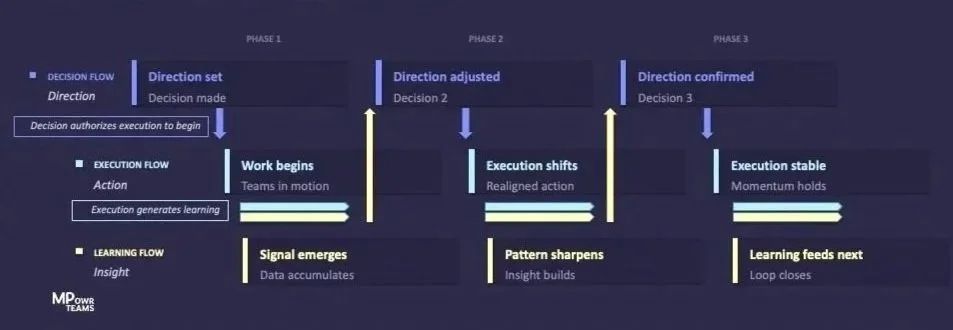
All initiatives move through three flows.
When they drift out of alignment, momentum leaks.
Every initiative runs Decision, Execution, and Learning flows simultaneously, repeating at every material decision point, not just named phase transitions.
When all three stay aligned, momentum holds.
MPowr Teams works at the point where these flows connect, designing the decision architecture that keeps all three aligned under pressure.
how we work
Four engagements.
One objective.
The right engagement depends on what you are navigating. The entry point always a conversation.
01 · Entry Point
Decision Assessment
90–120 min · Remote or On-site
A critical decision is in play. This session surfaces what's implicit, confirms authority, and tells you whether the decision structure is strong enough to hold through execution, before misalignment becomes rework.
02 · Core Engagement
Decision Stabilization
4–8 weeks · Remote or On-site
High-stakes decisions need to hold across functions, timelines, and pressure. This builds the architecture that makes them stick. Execution proceeds without relitigating what was supposed to be settled.
03 · Ongoing
Project & Portfolio Integration
2–8 months · Remote or On-site
When decision instability is a recurring pattern, this embeds decision readiness alongside milestone tracking, detecting compounding costs before any dashboard reflects them. Includes pathway to an internal Decision Architect capability.
04 · Working Sessions
Decision Architecture Lab
Half day to multiple days · Remote or On-site
For teams working through something consequential that isn't fully formed yet: pressure-testing a strategic plan before commitment, surfacing what's blocking alignment when the obstacle is more felt than named, or reaching a shared direction on something the team hasn't been able to close. Method calibrated to what the team needs.
Work with us
One conversation. No proposal. Just a clear look at
what’s underneath.
We start by listening. To understand what you're seeing and whether it's something we can help with. You decide what comes next.